
The Power of Us centre stage at Black, Indigenous and Workers of Colour Conference
Share
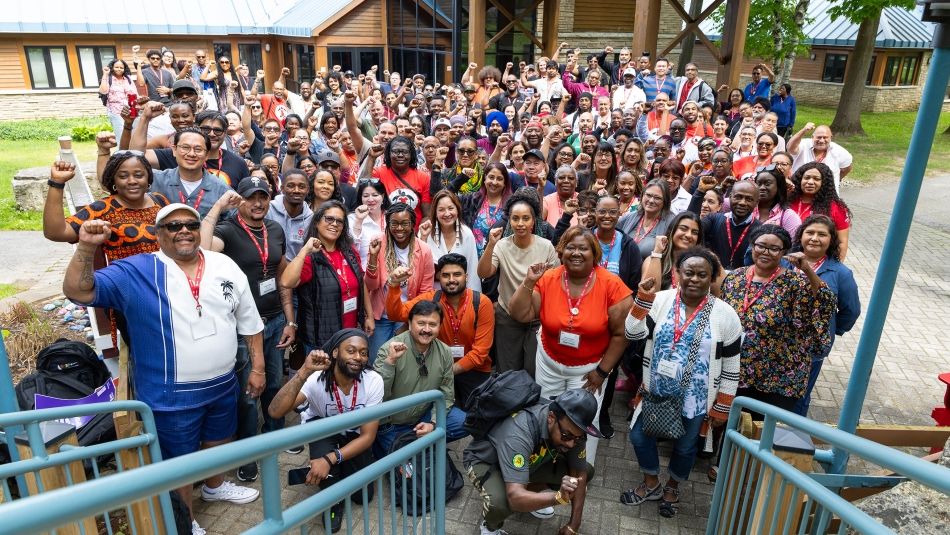
This year’s Black, Indigenous and Workers of Colour (BIWOC) Conference, held June 12-14, 2026, at the Unifor Family Education Centre in Port Elgin, Ont., explored the theme Status, Safety and Solidarity: The Power of Us.
Unifor Equity and Racial Justice Director Tricia Wilson invited more than 160 delegates to engage with tactile cards on their tables and anonymously share their histories so that, by the end of the weekend, the stories would generate a guide forward for the BIWOC community.
Each object on the table, including a globe, suitcase, flower and framed image of a continent, represented a different aspect of identity, resilience, leadership and belonging.
“Look at the globe, the addresses, the flags around the room, reflect on your home journey, or those of your ancestors, to Canada,” Wilson noted.
“All the threads are moving together and spell out part of history. But no single thread defines the whole story.”
By sharing stories, building skills and organizing for change, Black, Indigenous and workers of colour are helping create more equitable workplaces and stronger communities, said Unifor National President Lana Payne.
“The leadership, experiences and voices of Black, Indigenous and racialized workers strengthen our union and our movement,” said Payne.
“When workers come together to learn from one another, build solidarity and organize for change, all our communities become stronger.”
The weekend opened with a warm Indigenous welcome by Ronat John of the Bear Clan and a drumming circle by the Wabnookwe Singers.
Unifor Ontario Regional Director Samia Hashi highlighted the power of collective action to advance equity, defend public health care, end gender-based violence and protect Canadian jobs.
“Status, Safety and Solidarity. These pillars are really the story of our union. Because none of those things are ever handed to us,” she said.
“Workers don’t get status because someone decides to give it to them…Workers don’t get safety because employers suddenly decide it’s the right thing to do. We know it’s something we have to be adamant about, something we have to be loud about in order for it to be taken seriously. And all of this is possible because of your solidarity, and the work you’re doing at your locals and in your communities. It’s the reason we win.”
A panel moderated by Research National Representative Mike Yam, featuring Unifor International Department Director Navjeet Sidhu, Unifor National Representative Margaret Olal and Unifor Local 592 First Vice-President Ted Haggard explored the connections between migrant worker justice, racial justice, Indigenous solidarity and worker power.
The discussion highlighted how precarious work, low wages, insecure immigration status, racism and corporate power impact workers across sectors and communities.
“When one group of workers in a workplace has less rights than another group, it really lowers standards and conditions for everyone,” said Sidhu.
Olal reflected on standing alongside Amazon warehouse workers during their union organizing campaign.
“Amazon had told the workers, ‘If you sign the union card, you might lose your job,’” she recalled.
“Their determination was that they wanted to unionize their workplace, and they knew the benefits of the union.”
Haggard said unions and workers can build meaningful relationships with Indigenous communities, particularly in sectors such as forestry, mining and resource extraction, where work often takes place on or near Indigenous lands.
“Don’t just be a face in the crowd. Actually participate, be with the communities, ask them how you can support them, and form real partnerships,” he said.
Keynote speaker and University of Calgary professor Dr. Gideon Christian challenged delegates to examine artificial intelligence through the lens of racial equity.
He argued that AI is far from neutral when trained on data shaped by historical discrimination and warned that workplace technologies used for hiring, scheduling, surveillance and discipline can reproduce existing biases while appearing objective.
He urged unions to demand transparency, accountability and worker oversight whenever AI is introduced into workplaces.
“Our revolution today should not be against AI itself,” said Christian.
“Our revolution is against the way AI is being weaponized against racialized workers, to deepen racial inequality.”
Guest speaker Doran Ritchie, an Indigenous governance specialist, shared deeply personal and spiritual reflections on racism, colonialism and exclusion. Rather than focusing solely on racism as a political issue, he explored what those experiences can do to the human spirit.
“We know racism is real. We know it harms people, families, workplaces and communities,” he said.
“But when racism becomes the only thing we focus on, it can begin to shape the centre of our lives.”
Ritchie shared how racism touched his own life when his uncle was killed amid tensions surrounding Indigenous fishing rights in the 1990s. The experience, he said, taught him that people often carry invisible histories into workplaces and communities.
Healing, he said, requires reconnecting with identity, responsibility, community and self-awareness. For him, that healing came through his relationship with the land. True solidarity, he argued, comes from healing ourselves, protecting one another’s dignity and refusing to be defined by oppression.
“The power of us begins when I understand myself,” he said.
“When you understand yourself, and when we choose not to abandon each other in the process.”
Delegates also participated in workshops focused on public speaking, self-care and resilience, equipping them with practical tools to navigate the impact of world events and challenges facing Black, Indigenous and racialized workers.
On the final day of the conference, Alberta NDP leader Naheed Nenshi spoke via a pre-recorded message about rejecting division, defending diversity and continuing to fight for a more inclusive Canada, even when progress feels under attack, drawing on his experience as Calgary’s first Muslim mayor.
“We built a place where, regardless of who you are, regardless of where you come from, regardless of what you believe, you’re safe here and you have opportunity here,” he said.
Tricia Wilson later opened the floor to delegates during an open mic session, encouraging members to share ideas, concerns and feedback while reflecting on how to carry the lessons of the weekend back to their workplaces and communities.
“We built this incredible fire. And then we go home. And then, it’s Monday morning and day-to-day, business as usual,” said Wilson.
“In this group, there is so much power. This room is just a representation of the power in this nation, and how we can change things. We’re going to focus on us, and how we hold each other accountable, and how we protect each other.”
Unifor Indigenous Relations Director Gina Smoke wound down the weekend with a presentation on the meaning behind territorial acknowledgements, Indigenous rights, reconciliation, leadership and the importance of understanding Indigenous histories and identities, including Two-Spirit traditions.
Rather than treating land acknowledgements as a script to be recited, she encouraged delegates to make them meaningful and personal by understanding the territories they live and work on, the treaties that govern them and the relationships they represent.
“It isn’t saying, ‘you don’t belong there’ either. It’s just to recognize it as part of reconciliation,” she said.
“It’s acknowledging who we are, that we are here, or we have been here.”
In her closing remarks, Wilson returned to the tactile cards that had guided delegates throughout the conference, using them as a reminder that representation, belonging and solidarity are not boxes to check but commitments to carry forward.
She challenged delegates to continue building relationships, creating change and supporting one another long after the conference ended.
“This is not the conclusion. This is a launching point,” she said.
“When we find our collective balance, we become unstoppable. This is the power of us.”